
TL;DR
Hiring without an HR team is how most startups actually hire. A founder can own the judgement calls — role, bar, offer — if a simple workflow does the recruiter chores: a clear listing, comparable applications, a scored shortlist, and candidate updates. You do not need a department. You need a system you will use twice a week.
Definition
Hiring without an HR team is founder- or operator-led recruiting where there is no dedicated people function: one person owns the role brief, intake, screening, interviews, and offer, usually with a lightweight hiring workflow instead of a recruiter, an enterprise ATS, or a spreadsheet per job.
Startups lose people they wanted because the inbox is the ATS. The founder is in product, CVs sit in Drive, and “we’ll loop back Friday” becomes silence. Small business recruiting is not a smaller corporate TA team. It is hiring with no recruiter — and the teams that compete still look professional to the candidate.
Evidence
CIPD’s Resourcing and talent planning report 2024 found 69% of respondents said competition for well-qualified talent had increased over the last year. 84% had tried to fill some vacancies, and 64% of those had difficulty attracting candidates.
How Do Startups Hire Without an HR Team?
How do startups hire without an HR team?
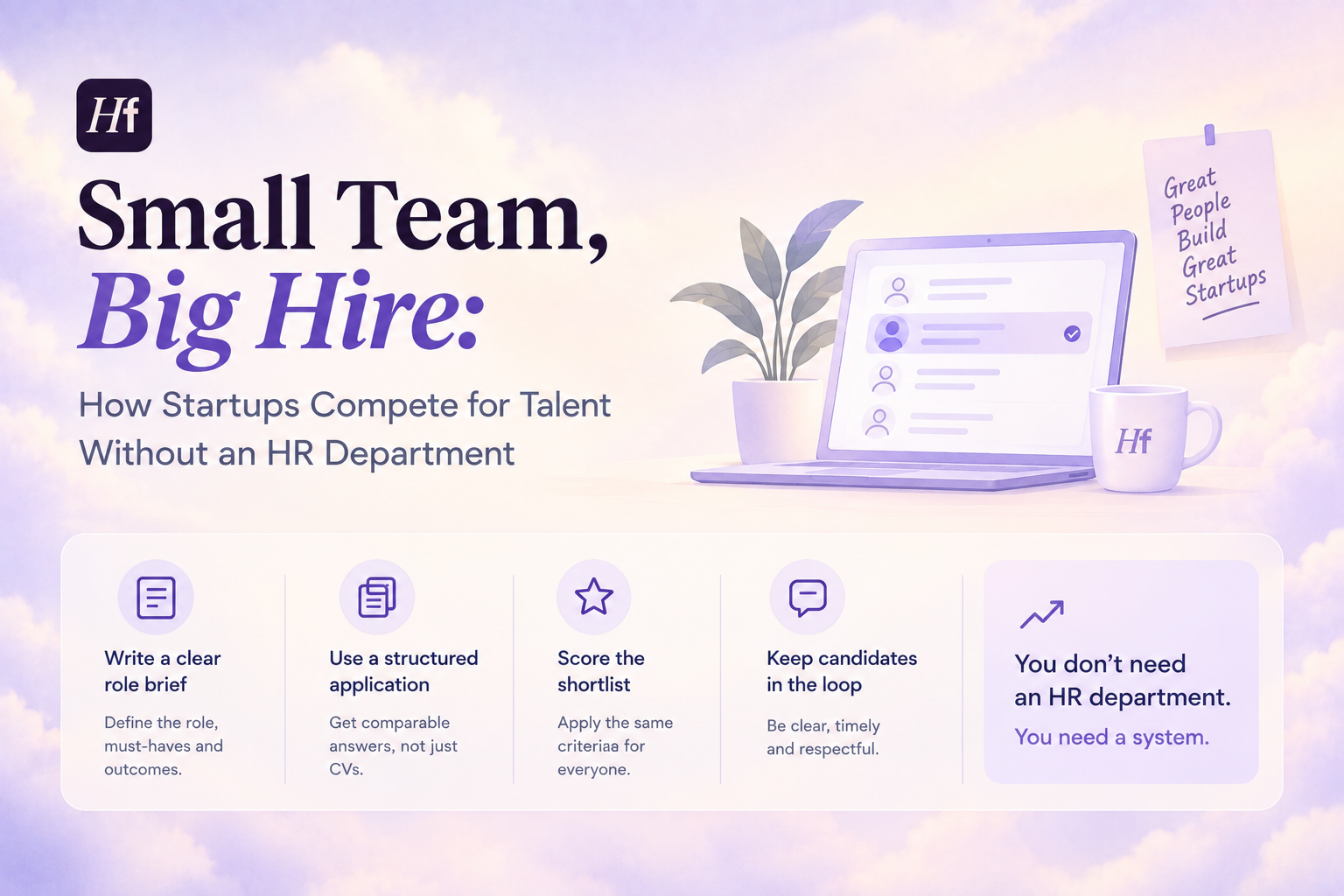
Startups hire without an HR team by making one person the hiring owner, writing the role before volume hits, capturing structured applications, scoring everyone on the same criteria, and sending a next step or a no. The founder still closes. The workflow replaces recruiter admin — not employment-law advice or payroll.
What usually sits with an early recruiter is not mystique. It is chores:
- Publish a role people can actually understand
- Collect answers you can compare
- Rank a pile without opening every PDF twice
- Keep a shared stage so nobody is “in Slack somewhere”
- Tell candidates what happens next
You can do that hiring with no recruiter if those five jobs have a home. Google Forms still works for a tiny one-off. It stops working when two roles overlap.
For more on why survey intake is not a pipeline, read Hiring Forms’ Google Forms vs. Hiring Forms: Why Spreadsheets Break Down When You’re Hiring.
Myth
“Hiring without an HR team looks unprofessional, so we should wait until we can hire a recruiter.”
Reality
Waiting is how you hire in a panic. Candidates judge speed, clarity, and whether anyone owns the process — not whether your website lists a People team. A written rubric and a branded listing beat a silent Drive folder.
| Recruiter chore | Founder with no system | Founder with a hiring workflow |
|---|---|---|
| Role brief | Verbal “we need someone senior” | Must-haves, knockouts, 90-day work |
| Intake | Forms + PDFs in email | Structured application on a listing |
| First pass | Late-night PDF skim | Shared score + knockout rules |
| Pipeline | Memory and Slack | Stages and notes in one CRM |
| Candidate updates | Ghosting until an offer | Template status when the stage moves |
Can a Founder Handle Hiring Alone?
Can a founder handle hiring alone?
Yes — for the first hires, a founder should handle hiring alone on the decisions that set the bar. What a founder should not handle alone is the admin: ranking unlike CVs, chasing interview notes, and remembering who is waiting. Own the close. Delegate the pile to a workflow, not to hope.
Matt Schulman, founder of Pave, told Y Combinator he personally recruited 100% of early employees because the first ten set the tone for the next hundred. That is founder judgement — not an argument for being the spreadsheet.
Expert Insight
“The first 10 employees are the most important aspect in the company’s life cycle – other than finding product-market fit – and recruiting has to be the founder’s priority.” — Matt Schulman, founder and CEO, Pave
Source: Y Combinator — Learnings of a CEO: Matt Schulman, Pave
When should you hire a recruiter instead of a workflow?
Hire a recruiter when you have multiple concurrent roles, hiring managers who will not run their own loops, and a founder calendar that cannot do screens. Until then, startup hiring tips that matter are ownership and SLA — not a job title. A workflow scales the first recruiter-shaped job. A person scales relationships and sourcing after that.
LinkedIn’s talent resources still treat time-to-hire as a core TA KPI: in 2021 the average from search to accepted offer was 41 days, and 62% of TA and HR leaders named it their most important success metric (LinkedIn Talent Solutions — a historical benchmark, and still why lean teams cannot afford a silent week). A founder can hit a few-day decision without HR headcount. A Drive folder rarely does.
| Signal | Stay founder-led | Add a recruiter or people lead |
|---|---|---|
| Open roles | One or two | Several at once, different functions |
| Volume | Manageable scored pile | Inbound you cannot rank in a sitting |
| Calendar | Founder can still close | Screens eat the week |
| Risk | Process slop, ghosting | Compliance load plus hiring load |
| Tooling | Listing + CRM + screening | Same tooling, plus a human owner |
Startup Hiring Tips That Replace Hiring With No Recruiter Chaos
What does “HR team in a box” actually mean?
For hiring ops, it means one system that publishes the job, captures structured applications, tracks stages, scores against your rubric, and sends updates — so hiring without an HR team still looks like a process. It does not mean payroll, leave policy, or legal advice in a subscription. Those still need a human or an advisor.
Definition
An “HR team in a box” for early hiring is a hiring-native workflow (branded listing, candidate CRM, knockout rules, AI screening as decision-support, template updates) that stands in for recruiter administration while the founder or hiring manager still makes the offer.
- Write must-haves, nice-to-haves, and knockouts before you post.
- Publish a branded listing with a structured application.
- Score every applicant on the same categories; keep knockouts pass/fail.
- Shortlist by threshold and interview with the same questions.
- Decide in a few days, then send a next step or a no.
- Only then debate a recruiter for the next wave of roles.
Hiring Forms is built for hiring, not surveys: listings, a candidate CRM, AI scores out of 100, knockout rules, and template updates. AI is decision-support. You still make the hire. Start with one role at hiringforms.io — signup includes 25 free AI screening credits.
For a first-pass system a founder can run, read Hiring Forms’ How to Screen Resumes Faster Without Losing Quality.
Practical startup hiring tips that cost discipline, not headcount:
- One hiring owner per role (the founder or the future manager)
- One source of truth (not email plus a Sheet plus WhatsApp)
- A scorecard used on every file
- A no that is sent, not implied
Did You Know?
CIPD 2024: 41% of organisations that selected candidates said new recruits always, mostly, or sometimes resigned within 12 weeks; 27% said selected people always, mostly, or sometimes no-showed on day one.
Lean-Team Hiring Context: Competing Without a People Function
A Bengaluru or remote-first startup hiring without an HR team is competing with companies that have brand, CTC, and a full-time recruiter. You will not out-process them with more PDFs. You out-process them with an honest listing, a fast screen, and a founder who still closes.
India-specific drag is operational, not decorative:
- Notice-period maths that you never wrote on the form
- Campus brand used as a fake knockout
- CTC “fit” treated as personality
- WhatsApp threads as the only candidate CRM
Put constraints on the application. Score role match. Do not discover deal-breakers in round three.
First-Hand Experience
Founder-led hiring usually fails in the middle, not at the idea. The role is posted. Then nobody owns the pile, notes live in chat, and the person you liked goes cold. Teams that put the recruiter-shaped job in a hiring workflow still interview like humans. They stop using the inbox as the HR department.
Evidence
Talent Board’s CandE 2025 cycle analysed feedback from more than 66,000 candidates across 110 companies. Award-winning employers consistently hit a three- to five-day go/no-go after interviews — an SLA a founder can keep without a TA team.
Source: Candidate Experience Institute — CandE 2025 Benchmark
Delay is how small teams lose. For more on that stall, read Hiring Forms’ Why Most Startups Take Too Long to Hire (And How to Fix It).
Can startups compete for talent while hiring without an HR team?
Yes — if the founder owns the bar and a workflow owns the pile.
A fairer, faster lean process can:
- ✓ Replace recruiter admin with listings, stages, scores, and updates
- ✓ Keep the founder on close conversations
- ✓ Hit a few-day decision SLA without a TA department
- ✓ Look professional without pretending you have People Ops
It cannot replace:
- ✗ A clear role brief and job-related knockouts
- ✗ Human judgement on who you might hire
- ✗ Payroll, legal, and people-management work that is not recruiting