
TL;DR
The cost of a bad hire is not one invoice. Replacement research puts the bill at a large share of salary—often more for technical and leadership roles—plus lost ramp time and another search. Avoid it by scoring role match before interviews, not by adding unstructured rounds.
Definition
The cost of a bad hire is the full impact of a bad hiring decision: recruiting and onboarding you cannot recoup, lost productivity while the seat is empty or filled poorly, manager time, team morale, and the second search when that person exits or is managed out.
Most founders do not miss the recruiting fee. They miss the quiet months: a seat that looks filled, work that still sits, and another search after the first person leaves. The cost of a bad hire is why lean teams need a scored first pass, not “we’ll know in week six.”
Evidence
Gallup estimates replacement cost at about 40% of salary for frontline roles, 80% for technical professionals, and around 200% for leaders and managers—before brand damage or lost customer relationships.
Source: Gallup — 42% of Employee Turnover Is Preventable but Often Ignored
How Much Does a Bad Hire Cost a Company?
How much does a bad hire cost a company?
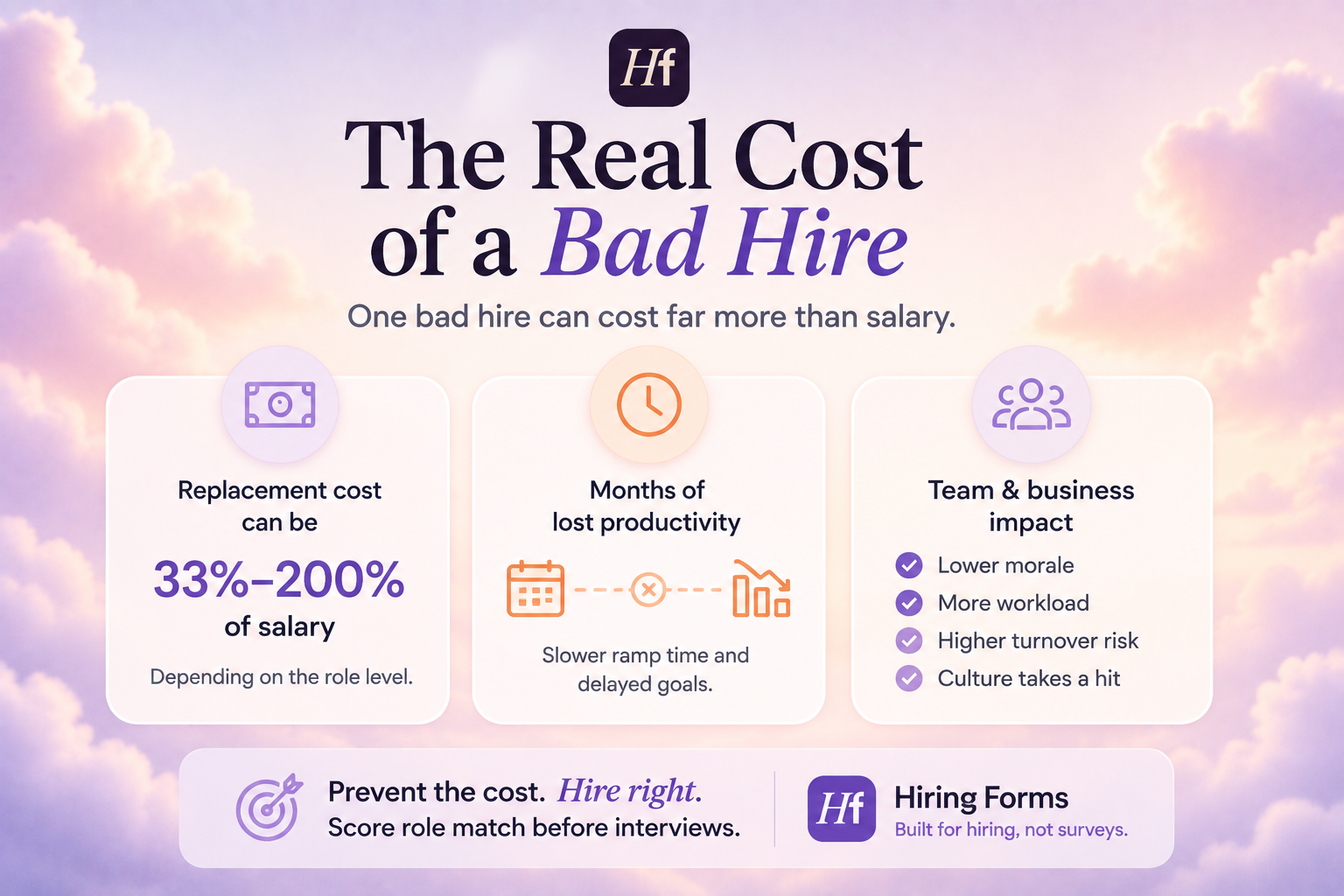
There is no single invoice. Conservative replacement ranges run from about one-third of salary to two times pay, depending on the role. A bad hire at a lean company also burns founder time, delays shipping, and can push remaining people toward the door. Treat the number as a planning range, then add the costs your spreadsheet never names.
Work Institute uses 33.3% of base salary as a planning figure for total turnover cost—about 11% direct replacement and the rest hidden drag (Work Institute). That is a floor, not a cap. Gallup has also framed replacement as one-half to two times annual salary and called that conservative (Gallup).
A practical way to size employee turnover cost after a miss:
- Recruiting spend and founder or recruiter hours
- A second interview loop
- Onboarding and training you cannot reuse
- Output lost during vacancy, ramp, and rework
- Exit or performance-plan time if you separate
Myth
“A bad hire only costs whatever we paid them until we notice.”
Reality
Salary during a weak tenure is the visible line. The expensive part is the empty-or-wrong seat: a second search, a team covering gaps, and first-year turnover that never returns the hiring investment.
| Role type | Replacement-cost range (research) | Why lean teams feel it |
|---|---|---|
| Frontline / ops | ~40% of salary (Gallup) | Coverage and retraining hit immediately |
| Technical professional | ~80% of salary (Gallup) | Roadmap slips while you re-source |
| Manager / leader | ~200% of salary (Gallup) | Team attrition and decision lag compound |
| Planning baseline (any role) | ~33% of base pay (Work Institute) | Use this if you need one conservative number |
What a Bad Hiring Decision Actually Includes
Is employee turnover cost the same as the cost of a bad hire?
They overlap, but they are not identical. Employee turnover cost covers any departure. The cost of a bad hire is narrower: you paid to select, onboard, and carry someone who should not have been in the role—then you pay turnover cost again when they leave or underperform. A regretted hire is turnover you bought on purpose.
Harvard Business Review notes that a bad hiring decision is expensive, replacement can run from thousands to hundreds of thousands of dollars, and morale and culture costs may still sit off the spreadsheet. Extra interview rounds do not automatically buy quality.
Work Institute’s 2025 Retention Report found as much as 40% of overall turnover happens in the first year—the window where a mismatch shows up and hiring spend is barely recouped (2025 Retention Report PDF).
Did You Know?
LinkedIn’s 2025 Future of Recruiting reporting found 89% of talent acquisition professionals say measuring quality of hire will become more important—yet only 25% feel highly confident their organisation can measure it.
Source: LinkedIn Talent Blog — Solving the Quality of Hire Riddle
Typical hiring mistakes that create that first-year bill:
- Résumé polish instead of comparable evidence
- Culture vibe as a knockout; role match as optional
- More interview rounds without a shared scorecard
- A rushed offer because the pile sat unread
- Knockouts discovered after the offer
For more on why unread piles push teams into rushed yeses, read Hiring Forms’ Why Most Startups Take Too Long to Hire (And How to Fix It).
How Do You Avoid Hiring the Wrong Person?
How do you avoid hiring the wrong person?
You avoid hiring the wrong person by defining must-haves before volume hits, scoring role match against a written rubric, applying knockout rules, and interviewing only the people who clear a threshold. Gut-feel chemistry is a data point. It is not a substitute for evidence that they can do the job.
Definition
Role-match scoring is a structured first-pass rating of how well an application maps to the work of the role—skills, scope, and proof of similar outcomes—separate from likability, school prestige, or “we liked the chat.”
LinkedIn’s quality-of-hire research shows TA teams already track a mix of signals: 66% use job performance, 60% track retention, and 44% assess skills match (LinkedIn). Prevention is doing that match before the offer.
- Write must-haves, nice-to-haves, and knockouts before you post.
- Capture structured answers so CVs are comparable.
- Score role match (and 2–4 other categories) the same way for every applicant.
- Rank the pile against that rubric—human or AI—then read the shortlist in depth.
- Interview with the same questions and a scorecard.
- Decide on a short SLA so silence does not force a panic hire.
AI scoring is one prevention method among several. Hiring Forms rates each applicant against custom categories—including role match—so the shortlist is ranked by the job you posted, not by who applied first. Humans still set the rubric and make the offer.
| Prevention method | Catches… | Does not catch… |
|---|---|---|
| Knockout rules | True disqualifiers | Nuanced skill depth |
| Role-match score | Weak evidence vs the actual work | Interview judgment and references |
| Shared interview scorecard | Inconsistent “gut” across managers | A vague role brief |
| Structured applications | Incomparable PDFs | Dishonest answers (verify later) |
| Fast, scored shortlist | Panic hires from an unread pile | Manager delay after interviews |
Expert Insight
“A bad hiring decision is expensive. Replacing an employee costs companies anywhere from thousands of dollars to hundreds of thousands of dollars. And this might just be the tip of the iceberg, as a poor hire will also have indirect costs, for example in regards to morale and company culture.” — Atta Tarki, Tyler Cowen, and Alexandra Ham, Harvard Business Review (July 2022)
Source: Harvard Business Review
Lean teams that want a scored first pass in one workflow can try Hiring Forms on a single role. Signup includes 25 free AI screening credits.
Lean-Team Hiring Context: Why a Miss Hurts Smaller Companies Harder
A 200% replacement ratio on a manager is painful anywhere. In a 12-person startup it can stall a product line. There is no bench. One bad hiring decision is payroll, morale, and the next hire you now cannot afford to get wrong.
India-based teams add timing risk: a 30–90 day notice period can land someone who then fails role match, while CTC and lost output continue. Put notice period, work-authorisation, and band on the form as knockouts.
First-Hand Experience
In conversations with founder-led teams, the expensive hire is rarely “we ignored a red flag in month four.” It is “we never scored role match, so we hired whoever followed up most.” Teams that rate applications against the job—and keep humans on the final call—spend less time unwinding first-year exits.
Evidence
Work Institute’s 2025 analysis of more than 120,000 exit interviews reported that 75% of departures were preventable. A mismatch at intake often shows up later as turnover you could have avoided.
Gallup finds 42% of voluntary leavers said their manager or organisation could have done something to keep them (Gallup). A weak hire can also accelerate the next resignation.
CandE 2025 coverage highlights a three- to five-day go / no-go after interviews among award winners. Speed without a rubric is how hiring mistakes get made; delay without a score is how you panic-hire.
For a practical first-pass system that protects role match, read Hiring Forms’ How to Screen Resumes Faster Without Losing Quality.
Is the cost of a bad hire big enough to change how you screen?
Yes—once you count replacement, ramp, and a second search, not just salary paid.
A stronger intake can:
- ✓ Size employee turnover cost as a salary multiple, not a guess
- ✓ Score role match before interviews
- ✓ Use knockouts so impossibilities never reach an offer
- ✓ Keep humans on the final hiring decision
It cannot replace:
- ✗ A clear role brief and honest must-haves
- ✗ Interview judgment and references
- ✗ Manager time after someone starts